Doctor visits are important, but they are also easy to forget. In one short appointment, a clinician may explain symptoms, review test results, name a diagnosis, change a medication, discuss side effects, and give follow-up instructions. Patients are often expected to remember all of this while they may be sick, anxious, tired, or overwhelmed.
That is a lot to carry from memory alone. Research has shown that patients forget a large share of the medical information they receive. One widely cited review found that 40 to 80 percent of medical information provided during healthcare visits is forgotten immediately, and that almost half of what patients do remember may be remembered incorrectly [1].
Audio recording doctor visits gives patients a reliable way to revisit what was said. It can help them understand instructions, review medical terms, involve caregivers, and follow through more confidently after the appointment.
Doctor visits are hard to remember
People often assume they will remember what a doctor says because the information is important. But medical visits can be stressful, fast-moving, and full of unfamiliar language.
A patient may be hearing test results, discussing pain, learning about a new diagnosis, or trying to understand a medication change. Even when a clinician explains things clearly, it can be hard to absorb everything in the moment.
Medical language also creates confusion. Research in JAMA Network Open found that patients often misunderstand common medical phrases and jargon [2]. That means a patient may remember a term but misunderstand what it means, or forget why it matters.
An audio recording helps solve this problem. Patients can listen again later, write down key terms, and prepare better follow-up questions.
Why record if the doctor's office already gives notes?
After-visit summaries, portal notes, and printed instructions are useful. Patients should read them and keep them. But office notes do not always replace the value of hearing the conversation again.
Doctor's office notes may summarize the visit, but they may not capture:
- The full explanation behind a diagnosis or treatment plan
- The reason a medication was changed
- The exact answer to a patient's question
- The warning signs the clinician emphasized
- The tone, context, or sequence of the conversation
- Questions asked by a caregiver or family member
- Clarifications that happened during the appointment
Notes can tell you what the plan is. A recording can help you remember how the plan was explained.
That difference matters. If a patient is confused about why a medication changed, when to schedule a follow-up, or what symptoms to watch for, the recording can provide context that a short summary may not include.
The best approach is not notes or recording. It is both. Office notes provide a written record. Audio recordings help patients revisit the conversation in the clinician's own words.
Recordings help patients understand and recall information
Research supports the value of recorded consultations. A systematic review of interventions to improve recall of medical advice found that audio recordings after consultations improved later recall in several studies [3].
Another review found that patients value having access to recordings and often use them. Across the studies reviewed, a weighted average of 72 percent of patients listened to their consultation recordings, and 60 percent shared them with others [4].
A separate systematic review focused on older patients found that consultation recordings mainly improved satisfaction, recall, fulfillment of information needs, and decision-making [5].
In practical terms, this means patients can replay the moment when the clinician explains a test result, medication change, side effect, or follow-up step. Instead of relying on memory, they can return to the source.
Recordings can support medication safety
Medication instructions are one of the strongest reasons to audio record a visit. A patient may be told to start one medication, stop another, change a dose, watch for side effects, or take a medicine at a specific time of day.
Those details can be easy to mix up after the appointment. A recording gives patients a way to review medication names, dosing instructions, and warning signs in the clinician's own words.
This is especially useful for people who take multiple medications, see multiple specialists, or manage chronic conditions. It can also help caregivers confirm what was discussed instead of relying on secondhand memory. Pairing a recording with an always-up-to-date medication list makes it easier to catch changes before they become mistakes.
Recordings help caregivers stay aligned
Many patients do not manage care alone. A spouse, adult child, sibling, friend, or caregiver may help schedule appointments, pick up medications, manage follow-up tasks, or watch for symptoms.
But caregivers cannot always attend every visit. Without a recording, the patient has to explain the appointment from memory. That can lead to confusion, especially after a complex visit.
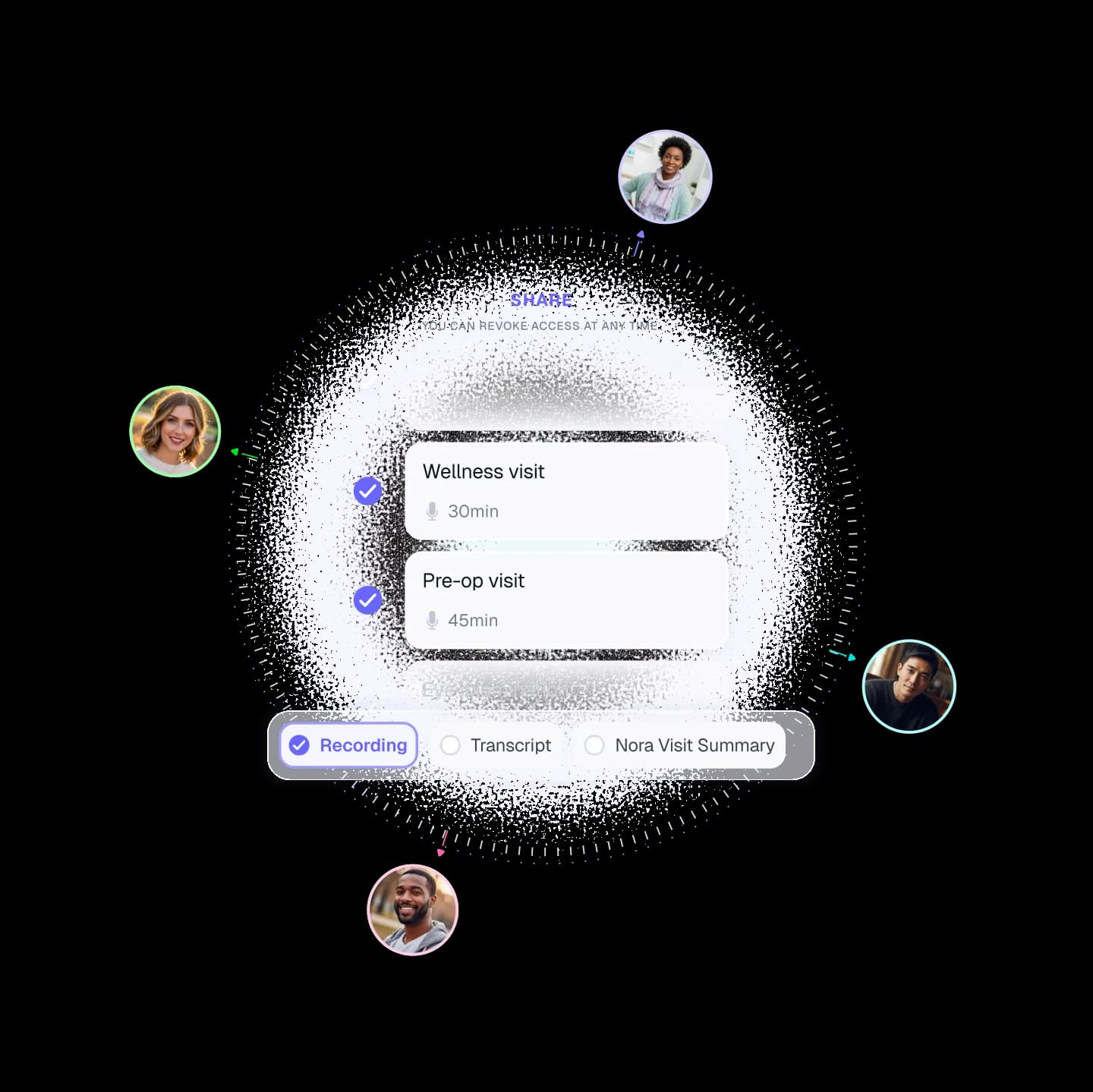
Audio recordings help everyone work from the same information. A caregiver can hear the instructions directly, understand the care plan, and help the patient follow through. AlignCare makes it easy to share visit details with caregivers so no one is guessing.
This can be especially valuable for older adults, people managing chronic illness, patients recovering from surgery, and families coordinating care from different locations.
Recordings are useful for chronic and complex care
For patients with ongoing health needs, doctor visits build on each other. One appointment may cover lab results. Another may change medication. Another may introduce a referral, imaging test, or new treatment option.
Over time, it can be hard to remember who said what and when.
Audio recordings create a personal record of care conversations. Patients can review past instructions, compare them with new recommendations, and prepare better questions for future appointments. Keeping labs, imaging, and after-visit notes together in a health document library makes that history even easier to follow.
This can make complex care feel more manageable. The patient does not have to rely only on memory, scattered notes, or incomplete recollections.
Recording should be done responsibly
Patients should understand their state's recording rules before audio recording a doctor visit. In one-party consent states, a patient who is part of the conversation can generally record without getting separate consent from the clinician. In all-party consent states, everyone involved in the private conversation generally must consent before recording starts.
Rules can vary depending on whether the visit is in person, by phone, or by telehealth. If the patient and clinician are in different states, the safest approach is to follow the stricter rule [6] [7]. For a full breakdown, see our guide to audio recording consent laws by state.
Even when consent is not legally required, asking first is often the best patient experience.
A simple script works well:
"Is it okay if I audio record this visit so I can review your instructions later?"
Or:
"I want to make sure I remember everything correctly. Would you be comfortable with me recording the audio?"
Patients should also keep recordings private and share them only with people involved in their care.
Why a voice memo app is not ideal for doctor visits
A standard voice memo app can capture audio, but doctor visits deserve a more private and organized place. Visits may include sensitive details, medication names, test results, and medical terms that are hard to interpret later.
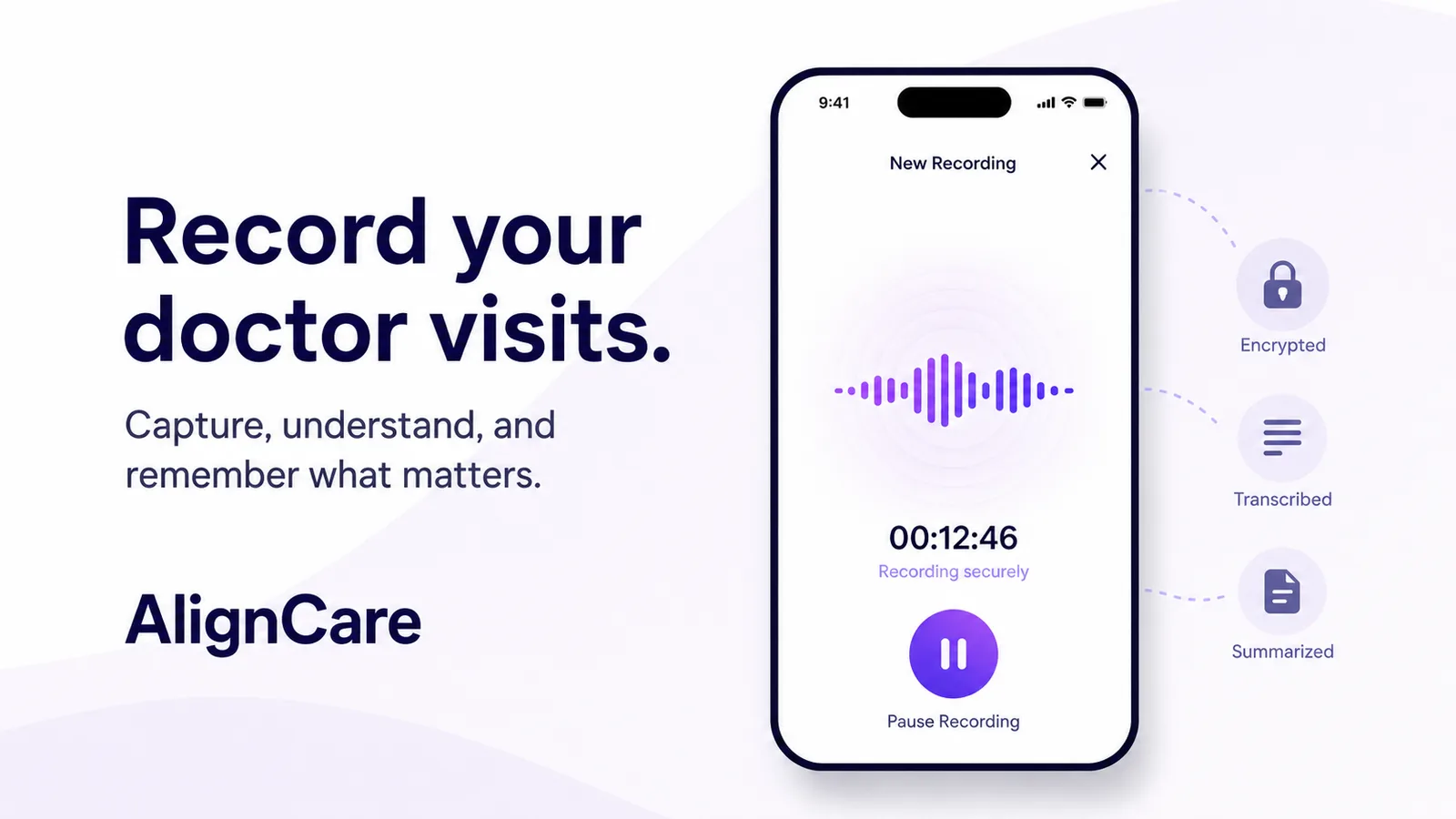
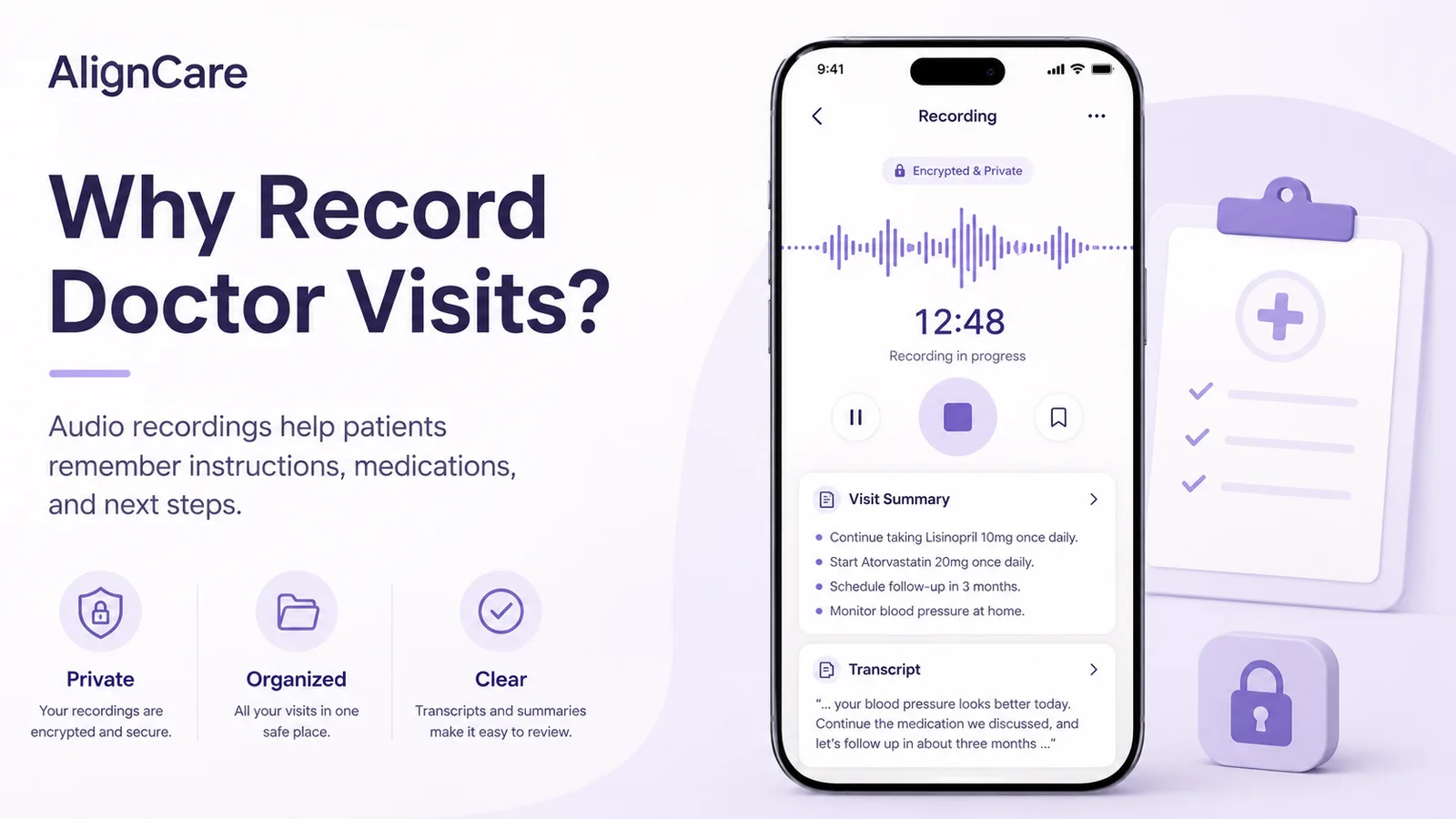
AlignCare is purpose-built for recording doctor visits on iOS and Android. It keeps visit recordings separate from everyday voice memos, encrypts patient data, and turns appointments into clear, plain-language summaries and transcripts that patients can access from their device [8].
That matters because the real value is not just having an audio file. The value is being able to understand it, revisit it, and use it to follow through.
You can download AlignCare here: Download AlignCare
Conclusion
Patients should audio record doctor visits because healthcare is too important to rely on memory alone. Research shows that patients often forget or misunderstand medical information, and studies suggest that recordings can improve recall, understanding, satisfaction, and decision-making.
Doctor's office notes are helpful, but they do not always capture the full conversation. Audio recordings give patients another layer of support. They help patients hear the explanation again, review medical terms, confirm medication instructions, involve caregivers, and stay more engaged in their care.
Used responsibly, audio recording can turn a fast appointment into information patients can return to, understand, and act on.
References
- Kessels, "Patients' Memory for Medical Information," Journal of the Royal Society of Medicine.
- Gotlieb et al., "Accuracy in Patient Understanding of Common Medical Phrases," JAMA Network Open.
- Watson and McKinstry, "A Systematic Review of Interventions to Improve Recall of Medical Advice in Healthcare Consultations," Journal of the Royal Society of Medicine.
- Tsulukidze et al., "Providing Recording of Clinical Consultation to Patients," Patient Education and Counseling.
- Dommershuijsen et al., "Consultation Recording: What Is the Added Value for Patients Aged 50 Years and Over?" PubMed.
- Justia, "Recording Phone Calls and Conversations: 50-State Survey".
- Reporters Committee for Freedom of the Press, "Introduction to the Reporter's Recording Guide".
- AlignCare.
Disclaimer
This essay is for general informational and educational purposes only. It is not medical advice, legal advice, or a substitute for professional guidance. AlignCare does not provide medical advice, diagnosis, or treatment. Always consult a licensed clinician with questions about your health, diagnosis, medications, or treatment plan. Recording laws vary by state and situation, and they may change. Consult a qualified attorney if you have legal questions about recording a medical visit.